


About Us
The Remote Sensing and GIS Department was established in 1976 as a division of the Central Laboratory for Space Research (now the Space Research and Technology Institute of the Bulgarian Academy of Sciences).
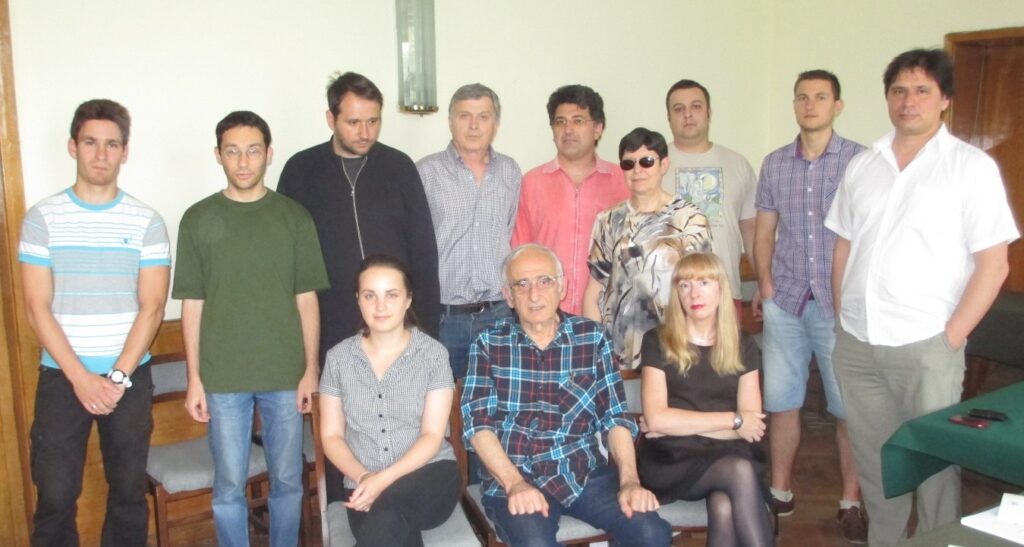
Activities
Since its founding, the department has implemented more than 60 scientific projects related to the study of Bulgaria’s territory. Through the integrated use of aerospace (remote sensing) and ground (in-situ) data, morphostructural zoning of the country has been carried out. Research has been conducted on geodynamics and neotectonics, and circular and linear morphostructures of different genesis containing various mineral resources (ores, oil, freshwater, etc.) have been identified.
In cooperation with Russian scientists during the 1970s, a methodology was developed and tested for visual-instrumental interpretation of aerospace scanner imagery. The spectral signatures of different land-cover types were determined, and the informativeness of multiband aerial images was assessed.
A methodology for complex landscape-geochemical and remote investigations of technogenically impacted regions was developed and applied to areas such as the Kardzhali Lead-Zinc Plant, the Devnya Industrial Complex, Sofia, and Kremikovtsi Metallurgical Combine. Numerous field and laboratory experiments were carried out to determine the spectral reflectance of various rock types and the surface layer of Bulgaria’s main soil types, and catalogues of these spectra were compiled.
Empirical relationships were derived between the spectral parameters of rock types and their mineral composition and textural-structural features. Similar studies were performed in Russia, Poland, the Czech Republic, Slovakia, Hungary, Romania, Mongolia, Cuba, Vietnam, and Central Asia as part of the Remote Sensing of the Earth working group under the international Intercosmos program.
As part of that program, reference “passports” were created for selected polygons and test areas in Bulgaria (Eastern Rhodopes, Plovdiv, Pleven, Shumen, Rila), including classification of the tasks solvable by aerospace technologies. International synchronized ground and aerial experiments were conducted at test sites such as Patriarch Evtimovo, Popovo, Novi Pazar, Belozem, and Bolyarino.
Members of the department participated in the planning, execution, and data processing of complex sub-satellite experiments conducted within the Intercosmos member states during international crewed space missions under the projects Study of Geosystem Dynamics by Remote Methods and Inland Water Bodies: Kursk-85 (Russia), Telegeo-87 (Poland), Mizia-88 (Bulgaria), Caribe and Tropic-1 (Cuba), Gobi–Hangai, Khubsugul, Orkhon, Erdem (Mongolia, 1981–1984), Züsser See 83 (GDR), Kuulong and Dalat (Vietnam, 1976–1990), Tian-Shan (1988–1990), Günesh 84 (Azerbaijan), Telč 76 (Czechoslovakia), Rybinsk (Russia), and Pchelina (Bulgaria).
These complex experiments used aircraft-laboratories equipped with scientific instruments, including panchromatic and multiband cameras, scanners, and Bulgarian-developed systems such as the 15-channel airborne spectrometric system “Spektar-15 MS” (400–836 nm) and the radiometric system “RM-1S” (λ = 4 cm). Simultaneously, ground measurements were made using the 20-channel spectrometer ISOH-020 (400–800 nm).
A significant portion of these experiments addressed agricultural applications—specifically, the dynamics of the spectral reflectance of major crops across vegetation phases. Empirical relationships were established between vegetation indices (VI, NDVI) and certain biophysical characteristics of the soil–vegetation system, as well as between the measured radio-brightness temperature at λ = 4 cm and soil surface moisture.
Participation in National and International Programs
The department has actively participated in numerous national and international scientific programs, including:
- National Program “Remote Aerospace Methods for Studying Earth Resources, Ecology, and the National Economy” (1976–1980)
- National Coordination Program “Remote and Aerospace Methods for Earth Studies and National Economic Applications” (1980–1985)
- National Program “Cosmos–Earth” (1988–1990)
- Remote Sensing Working Group within the Intercosmos International Program (1975–1990)
Participation also included major space research initiatives:
- Scientific program for the first Bulgarian cosmonaut – experiment Biosphere-B (1978–1979)
- Scientific program “Shipka” for the second Bulgarian cosmonaut – project Georesurs with experiments Thrace, Mizia, Loess, Balkan, Pollution, Black Sea, the global project Earth, and development of instruments Therma and Parallax–Zagorka (1987–1990)
- Instrument package “Bulgaria 1300 – II” aboard the Meteor–Priroda satellite (1980–1985)
- International “Phobos” project for the study of Mars and its moon Phobos (1982–1988)
- International targeted space project “Priroda” for Earth observation from the Mir space station (1988–1991)
During 1994–1996, department members participated in the international CORINE Land Cover 1990 project for Bulgaria under the PHARE program.
In recent years, the department has contributed to research projects under the scientific plan of SRTI–BAS, contracts with the National Science Fund, municipalities, private firms, and international projects funded under the EU Sixth Framework Programme, SEE-ERA.NET, INTAS, and BELSPO, as well as the Preparatory Programme for PROBA-V.
Scientific Output
The results of these research activities are reflected in 10 individual and 23 collective monographs and 9 books. Over 1,500 scientific articles have been published in national and international journals, and more than 30 patents for inventions have been obtained. Members of the department have received numerous national and international awards for scientific and applied achievements.
Resources
The department maintains a scientific-information complex with thematically organized archives of satellite and sub-satellite data for aerospace polygons across Bulgaria. It also provides specialized software (for non-commercial use) for image processing and geodatabase development, including Leica ERDAS Imagine Professional, Leica Photogrammetric Suite Core, ENVI 4.6, and ArcGIS ArcInfo 9.2.
Vision and Priorities
The research activities of the department are aligned with its mission, as approved by the Founding Scientific Council of SRTI-BAS. Its focus is on the development, advancement, and transfer of technologies for Earth observation, GIS, and ground-based environmental monitoring methods.
This thematic direction corresponds to one of the priority research areas of SRTI-BAS and is part of Policy 2: Scientific Potential and Research Infrastructure within the European Research Area framework (Program 2.2: Study of Climate, Earth, and Space from the Program for Stabilization and Development of BAS 2012–2014 and the Strategic Directions and Priorities of BAS).
The department aims to contribute actively to the knowledge-based society and to be an effective partner in the European Research Area through scientific projects and strengthened cooperation with related institutions in the fields of remote sensing and GIS. It also fosters academic growth and professional realization of its researchers—most of whom are young scientists specializing in Earth observation and GIS technologies.